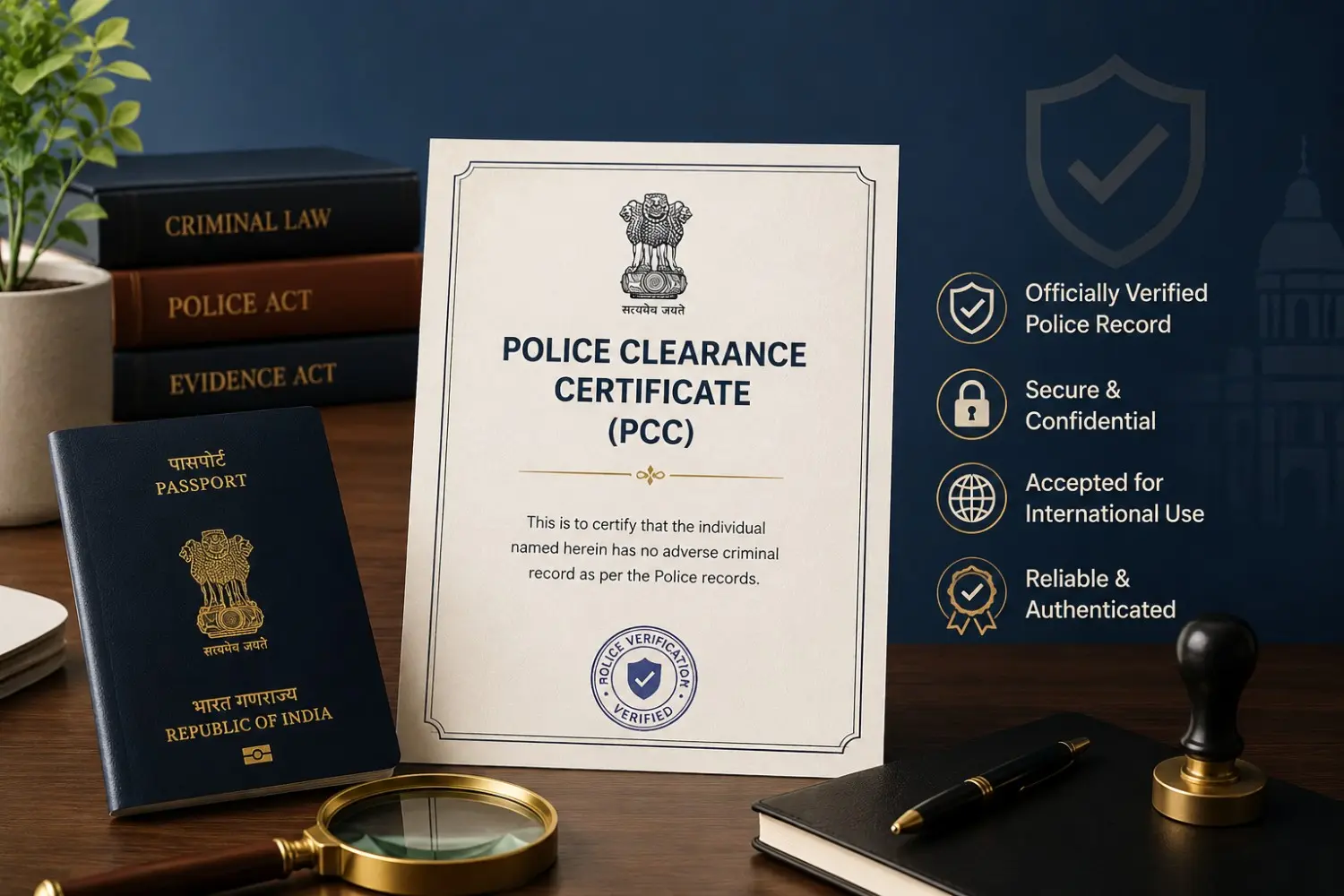
What is a Police Clearance Certificate (PCC)? Full Form & Meaning
A Police Clearance Certificate (PCC) is an official “clearance certificate” issued either by the police authorities or the appropriate designated government agency with respect to the individual’s stay in India for the specified duration.
PCC is issued iterating as to whether the individual had/has any criminal record or adverse information registered against them within a particular jurisdiction. The certificate acts as an evidence that he/she abided the law, had good conduct, and a clean record.
When an individual who has resided in India for a certain period of time and he/she is planning to migrate to another country for purposes such as employment, education, marriage, acquiring citizenship of another country etc., a PCC is often provided to the foreign governments, employers, educational institutions, immigration authorities etc.
PCC is a vital document to be submitted for situations such as-
-
Application of Visas.
-
Permanent Residency or Citizenship Applications.
-
Application of OCI i.e. Overseas Citizen of India.
-
Employment in a foreign country.
-
Application for enrolment in a foreign college or university.
-
Overseas marriage registration.
Types of PCC in India: Which One Do You Need?
There are two primary channels through which a PCC is issued in India:
1. PCC via Passport Seva Kendra (Ministry of External Affairs)
If an Indian National requires a PCC to be used in a foreign country, this is the most common route to do the needful. The application is made through the official website and the PCC is issued after due scrutiny by the Ministry of External Affairs, in coordination with the local police.
2. PCC via Delhi Police / State Police Authority
Residents of Delhi or any State in India can also obtain a PCC directly by approaching the concerned police authority of their State. Such applications are accepted both online through their portals and offline as well. After due verification and background check, the PCC is issued.
Which Documents Are Generally Required for PCC Application in India
-
Valid Passport — original + self-attested photocopy of the first and last pages.
-
Aadhaar Card / Voter ID / any valid government-issued address proof.
-
If the premises were rented, a Rent Agreement or Lease Agreement in that case.
-
If the individual was placed in India for a specific project, then the basic project details and proof of such placement.
-
Recent passport-size photographs (white background, as per government specifications)
-
Proof of purpose for which a PCC is required.
Step-by-Step: How to Apply for PCC Online in India
|
Steps
|
Process
|
|
Step 1
|
Register on the Passport Seva Portal or at the appropriate embassy if you are residing abroad
|
|
Step 2
|
Fill the PCC Application Form
|
|
Step 3
|
Pay the appropriate fee/levy to process the application
|
|
Step 4
|
Schedule an Appointment
|
|
Step 5
|
Get the Police Verification Concluded in India and Attend the Appointment
|
Once the above steps are concluded, a PCC is issued on successful verification.
Top 5 Reasons Why PCC Applications Get Delayed or Rejected
Many PCC applications face unnecessary delays such as –
-
Mismatch in the address- Address provided is different from the one stated in the passport or the address is vague, confusing, not complete.
-
Discrepancy in name or other details- The documents submitted should have correct details of name, surname, address, parents name, birth particulars etc. Discrepancy can lead to delays.
-
Non Availability of anyone at the address provided- Someone should be available to coordinate with the police authorities when the police visits.
-
Submission of incorrect documents- The documents are incomplete or not valid.
-
Missing addresses- Lets say an individual has resided at multiple addresses in India in different cities, states etc. All addresses must be disclosed else the application gets rejected.
Many PCC applications face unnecessary delays such as –
-
Mismatch in the address- Address provided is different from the one stated in the passport or the address is vague, confusing, not complete.
-
Discrepancy in name or other details- The documents submitted should have correct details of name, surname, address, parents name, birth particulars etc. Discrepancy can lead to delays.
-
Non Availability of anyone at the address provided- Someone should be available to coordinate with the police authorities when the police visits.
-
Submission of incorrect documents- The documents are incomplete or not valid.
-
Missing addresses- Lets say an individual has resided at multiple addresses in India in different cities, states etc. All addresses must be disclosed else the application gets rejected.
PCC for NRIs and Indians Living Abroad
Getting a PCC issued in India becomes slightly cumbersome for individuals not residing in India. Additional steps may be required to be carried out such as-
-
Application through Indian Embassy or High Commission abroad –
The application for PCC is to be applied at the country of residence, who then forward the request to the relevant State police authority in India.
-
Appoint a Representative in India to Coordinate with the Police Authorities-
Once the application is made, the representative in India should coordinate with the authorities on behalf of the applicant to manage the application and oversee its progress. Since the PCC will be issued from India, the verification takes place at the address provided in the application. If there have been multiple addresses, the verification takes place at all addresses. Engaging the services of a law firm or a lawyer helps in timely completion of this process as many a times police verification gets stalled or delayed due to address discrepancy, unavailability of anyone at the address provided, different States being involved etc.
Conclusion
Obtaining a Police Clearance Certificate in India is a process that requires due coordination with the appropriate authorities and proper submission of application along with documents. For NRIs, those with complex address histories across different cities in India, professional legal guidance is important.
At Malik Law Offices India, our immigration and NRI legal team has extensive experience assisting clients both in India and abroad with PCC applications, police verification follow-ups, apostille of documents issued in India and complete immigration legal support. We serve clients across Delhi NCR, Mumbai, Bangalore, Hyderabad, Punjab, Gujarat, and NRIs across the globe.